

What Professional Packers Do Differently (And Why It Matters)

Moving is one of those things that seems simple until you're knee-deep in bubble wrap, surrounded by half-filled boxes, wondering why your kitchen alone has taken three days. If you've ever tried to pack up a home yourself, you know the exhaustion that sets in—the endless decisions about what to wrap, what to toss, and how to fit everything into boxes that never seem to be the right size.
Most people assume packing is just putting things in boxes. But there's a reason professional packers can do in one day what takes most families a week or more. It's not just speed. It's method, materials, and knowing exactly how to protect what matters most. For families preparing for a move in Scottsdale or the surrounding area, understanding the difference can change the entire experience.

Here's what actually separates professional packing from the DIY approach—and why it matters more than most people realize.
It Starts With a System, Not a Box
When most people pack, they start with whatever room feels easiest and work through the house in no particular order. Boxes get filled with random items. Labels say things like "kitchen stuff" or "misc." By the end, nobody remembers what's where, and unpacking becomes an archaeological dig.
Professional packers work differently. Before anything goes into a box, we assess the entire home. We identify fragile items, high-value pieces, and things that need special handling. We map out which boxes go to which rooms in the new home. We determine the packing sequence so that essentials stay accessible until the last moment and come out first on the other end.
This systematic approach means your coffee maker isn't buried under winter coats. Your medications aren't lost in a box labeled "office." Everything has a place, a label, and a logical order. When you arrive at your new home, unpacking isn't a guessing game—it's a straightforward process.
Materials That Actually Protect Your Belongings
Here's something most people don't think about: the boxes from the liquor store aren't designed to protect your grandmother's china. They're designed to hold bottles upright for short trips. The newspaper you're using to wrap dishes will leave ink stains on your white serving platters. The tape from the dollar store will fail in the Arizona heat.
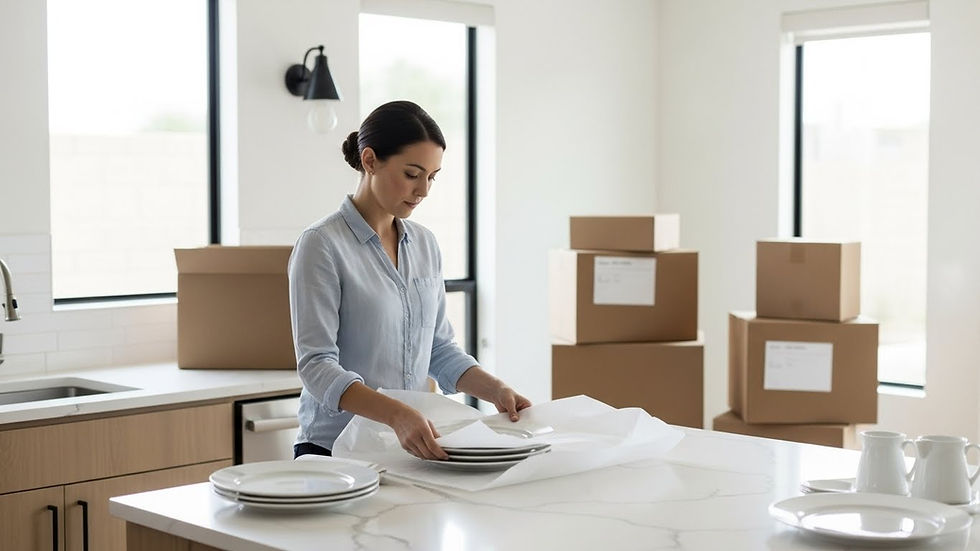
Professional packing and unpacking services use commercial-grade materials designed specifically for relocation. Double-walled boxes that stack without crushing. Acid-free packing paper that won't damage fabrics or leave residue. Bubble wrap in multiple densities for different protection levels. Custom crating for artwork, mirrors, and antiques that standard boxes can't protect.
The materials matter, but knowing how to use them matters more. Dishes go in vertically, not flat, because they're stronger on their edges. Heavy items go in small boxes, light items in large ones—the opposite of what feels intuitive. Fragile items need cushioning on all six sides, not just the top and bottom. These details are second nature to professionals. They're learned through thousands of moves.
Why Professional Packers Work Faster Without Cutting Corners
One of the biggest misconceptions about hiring professionals is that faster means less careful. In reality, professional packers work quickly because they've done this thousands of times. There's no hesitation about how to wrap a lamp base. No trial and error with the tape gun. No wasted motion trying to figure out the most efficient way to empty a closet.
A professional team can typically pack a 3,000-square-foot home in a single day. That same job takes most homeowners a week or more of evenings and weekends. But speed comes from expertise and repetition, not from cutting corners. Every item still gets proper protection. Every box still gets a clear label. Every fragile piece still receives the attention it needs.
For families balancing careers, children, and the thousand other details of a move, this time difference isn't a luxury—it's practical. Your time has value. Professional packing respects that.
Handling Valuables and Collections
If you own fine art, antiques, wine collections, or designer wardrobes, professional packing becomes even more important. These items require specialized knowledge that goes beyond wrapping something in paper and hoping for the best.
Our team has handled museum-quality artwork, vintage furniture, and collections that represent decades of careful acquisition. Each category has its own requirements. Oil paintings should never be packed flat. Antique wood furniture needs humidity considerations. Wine collections require temperature-stable packing. Vintage textiles need acid-free tissue, not regular packing paper.
For high-value items, we create detailed inventory and condition documentation. We photograph pieces before packing, note any existing wear, and ensure everything arrives exactly as it left. This level of attention is standard for our team—it's part of how residential move management works when it's done right.
The Unpacking Side of the Equation
Here's where professional packing truly separates itself: the unpacking. Most people think of packing and unpacking as separate tasks, but they're two halves of the same process. How something is packed directly determines how easily it can be unpacked and organized.
When our team packs your home, we're already thinking about what happens on the other end. Boxes are labeled not just with room names but with contents and priority. Items you'll need immediately—medications, phone chargers, toiletries, coffee essentials—are packed separately and marked clearly. Kitchen boxes are organized so unpacking flows logically rather than chaotically.
And when we unpack, we don't just pull items out of boxes and leave them on counters. Every unpacking service includes professional organizing. Your kitchen gets set up with systems that make sense. Closets are arranged. Bathrooms are functional. You walk into a home that's ready to live in, not a home surrounded by empty boxes and piles waiting to find their place.
This is the part that changes the moving experience entirely. Instead of spending weeks—sometimes months—trying to get settled, you're settled on day one.
The Real Cost Calculation
When families consider professional packing, the first question is usually about cost. That's fair. But the calculation most people do—comparing the price of professional packing against doing it yourself for "free"—misses important factors.
First, your time has real value. If packing takes you 40 hours and your time is worth $50 an hour, that's $2,000 in opportunity cost before you've bought a single box. Second, materials add up. Professionals buy supplies at commercial rates; you'll pay retail for products that often aren't as effective. Third, there's risk. One broken heirloom, one damaged piece of furniture, one cracked television—and suddenly professional packing looks like smart insurance.
Some items can't be replaced at any price. The antique sideboard from your grandmother. The artwork from your honeymoon. The custom furniture built for your space. Professional packing protects belongings, but it also protects memories.
Finding the Right Professional Packers
Not all packing services are equal. Some moving companies offer packing as an add-on, done by the same crew that loads trucks—people trained for lifting, not for protecting delicate items. Others focus on organizing but don't understand the logistics of an actual move.
The right partner understands both. At The Organized Move, packing is the foundation of everything we do. Our team includes professionals certified through NASMM (the National Association of Senior & Specialty Move Managers), trained to handle everything from everyday household items to irreplaceable collections. We've been doing this for over 18 years, and we approach every home with the same attention to detail.
Whether you're helping a parent downsize from a longtime family home or preparing your own family for a move across town, professional packing sets the tone for everything that follows.
Ready to see the difference? Schedule a complimentary consultation and let's talk about your move.


Comments